
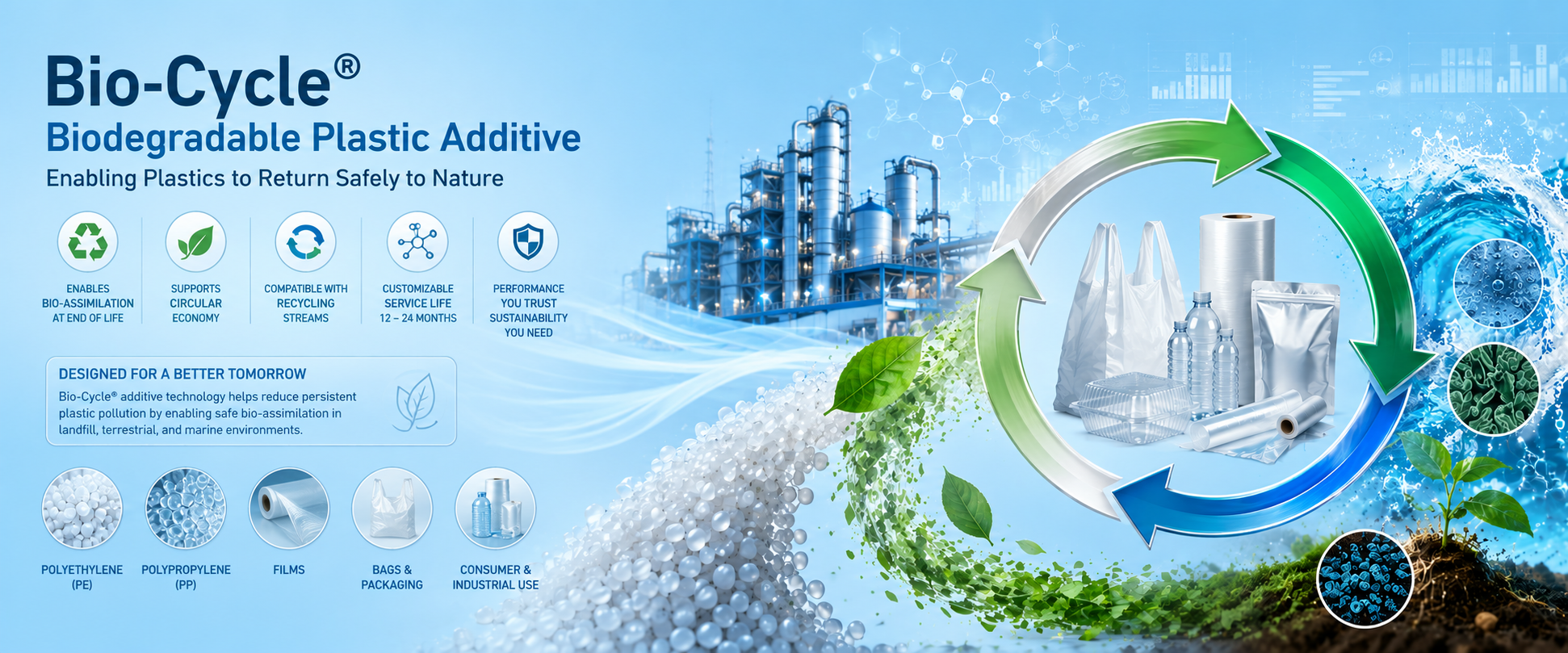
Biodegradable Plastic Additive For End-of-Life Plastics
Plastic products play a vital role in modern life, but managing plastic waste after use remains one of the industry’s biggest challenges. NuviaChem advanced biodegradable plastic additive masterbatch technology designed to help plastic products safely bio-assimilate at the end of their useful life while maintaining performance, recyclability, and manufacturing efficiency throughout their service life. Engineered for polyolefin applications such as polyethylene (PE) and polypropylene (PP), the biodegradable plastic additive technology supports a more sustainable approach to plastics by enabling responsible end-of-life management without compromising product performance.
Bio-Assimilation Additive Technology For Circular Plastic Solutions
Unlike conventional approaches that may simply fragment plastic into smaller particles, NuviaChem biodegradable plastic additive masterbatch is designed to facilitate a biological degradation pathway that allows microorganisms to consume and convert plastic waste into naturally occurring substances such as biomass, water, and carbon dioxide. The technology remains compatible with recycling systems as well as virgin resin materials and can continue functioning even after multiple recycling cycles, making it an ideal solution for manufacturers pursuing circular economy goals. By enabling plastics to safely bio-assimilate without leaving persistent microplastics behind, the product helps reduce long-term plastic pollution and supports a cleaner, more sustainable future.
How NuviaChem Biodegradable Additive Masterbatch For Plastics Works?
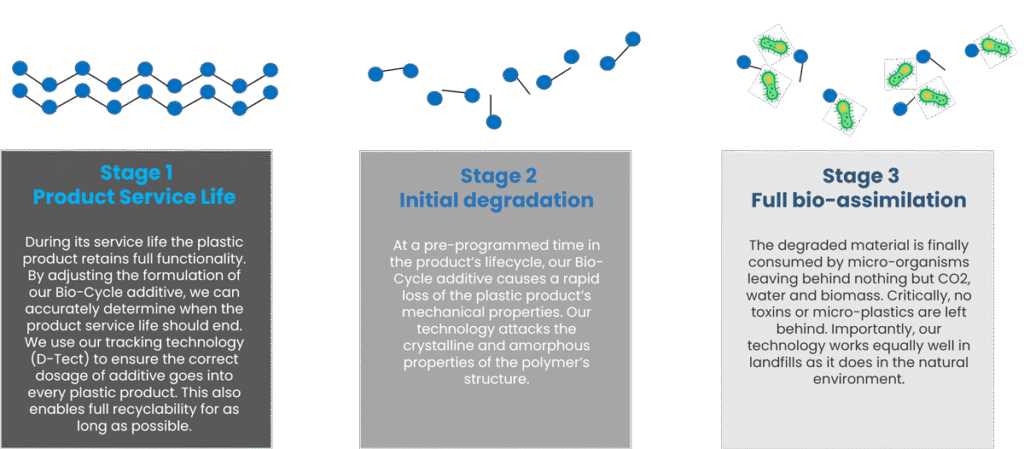
NuviaChem biodegradable plastic additive masterbatch is engineered to provide reliable product performance throughout its intended service life while enabling responsible end-of-life management. The technology works through a controlled three-stage process.
In Stage 1, the plastic product maintains its full functionality, strength, and durability during normal use, with the additive formulation customized to achieve the desired service life.
In Stage 2, once the predetermined lifespan has been reached, the additive initiates a controlled degradation process that reduces the polymer’s molecular structure and mechanical integrity, preparing the material for biological consumption.
Finally, in Stage 3, naturally occurring microorganisms consume the degraded material and convert it into naturally occurring substances such as biomass, water, and carbon dioxide.
This bio-assimilation process is designed to leave no persistent microplastics behind, supporting a future with less plastic pollution and fewer microplastics in the environment while remaining compatible with recycling systems throughout the product’s useful life.
Bio-Cycle® is supplied in masterbatch form, allowing easier dosing, improved dispersion, cleaner handling, and more consistent performance during plastic processing. The masterbatch format can be incorporated directly into standard manufacturing operations without significant changes to existing equipment or production procedures.
Benefits of Bio-Cycle® Biodegradable Additive
- No interference to production
processing - Low inclusion rate (1%)
- Compatible with recycled polyolefins
- Guaranteed functional life can be
customized - 100% recyclable and designed for
circular models - If not recycled, will bio-assimilate in
marine, terrestrial and anaerobic landfill
environment - Critical safety net to protect against
microplastics
Applications For Bio-Cycle® Additive
- All polyolefins (such as polyethylene
and polypropylene) - Protective packaging: stretch film, shrink
film, bubble wrap - Extruded films: printing, laminating,
barrier, sealant - Short service life items: trash bags,
shopper bags, fast food packaging - Agricultural film applications: mulch,
crop protection materials - Food service items: straws, lids, stir sticks,
cutlery, cups, plates;
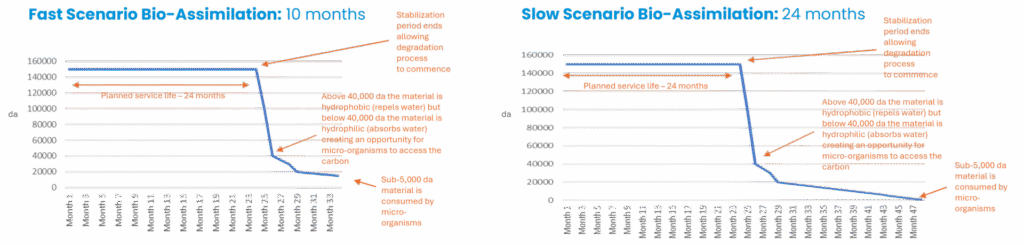
Our Biodegradable additive-Customizable Plastic Service Lifespan Control
Bio-Cycle® can be tailored to meet the expected service life of the finished product. Depending on application requirements, formulations are typically designed to maintain product integrity for 12 to 24 months before initiating the bio-assimilation process. This ensures reliable performance during storage, transportation, and normal product use.
Maintains Mechanical Performance During Use
Powerful stabilization systems help preserve the physical and mechanical properties of plastic products throughout their intended lifespan. Manufacturers can continue producing high-quality products without compromising durability, appearance, or functionality.
Compatible with Existing Manufacturing Processes
Bio-Cycle® is designed for seamless integration into conventional plastic processing operations. The additive requires only a low inclusion rate and can be incorporated into extrusion, blown film, cast film, injection molding, and thermoforming applications without major equipment modifications.
Supports Recycling and Circular Economy Initiatives
Unlike many end-of-life technologies that interfere with recycling streams, Bio-Cycle® is engineered to remain compatible with mechanical recycling processes. Plastic products containing the additive can be collected, recycled, and reused before biodegradation is triggered at the end of their lifecycle.
Reduces Persistent Microplastic Pollution Risks
When plastic waste escapes collection systems and enters the environment, Bio-Cycle® technology is designed to facilitate biological consumption rather than leaving long-term plastic fragments behind. This helps address concerns related to persistent plastic pollution and microplastic accumulation.
Effective Across Multiple Disposal Environments
Bio-Cycle® technology is designed to function in a variety of end-of-life environments, including landfill, terrestrial, and marine conditions. Environmental factors such as microbial activity, climate, and UV exposure influence the rate of bio-assimilation.
Ideal for Flexible Packaging Applications
The additive is suitable for a wide range of flexible packaging products, including:
- Stretch films
- Shrink films
- Bubble wrap
- Protective packaging
- Lamination films
- Sealant films
- Printing films
Designed for Consumer and Retail Packaging
Bio-Cycle® can help manufacturers improve sustainability profiles across various consumer packaging products, including:
- Shopping bags
- Trash bags
- Fast food packaging
- Food service items
- Disposable packaging solutions
Agricultural Film Sustainability Solutions
Agricultural plastic products can create significant end-of-life waste challenges. Bio-Cycle® offers an environmentally responsible solution for applications such as:
- Mulch films
- Crop protection films
- Agricultural packaging
- Seasonal plastic products
Why Choose NuviaChem Biodegradable Masterbatch?
As governments, brands, and consumers increasingly demand sustainable packaging and responsible waste management solutions, our product provides manufacturers with a practical pathway toward improved environmental performance. By combining recyclability, manufacturing compatibility, and end-of-life bio-assimilation, Bio-Cycle® helps bridge the gap between today’s plastic economy and tomorrow’s circular materials future.
Testing and Performance Validation for Biodegradable Additive Masterbatch
NuviaChem biodegradable plastic additive technology has been evaluated using internationally recognized standards to verify its biodegradation and bio-assimilation performance under controlled testing conditions. Independent testing and validation support the technology’s ability to facilitate the biological breakdown of plastic materials at the end of their useful life.
Bio-Cycle® has been:
- Tested to EN 16472 – Assessment of the biodegradation of plastic materials under simulated environmental conditions.
- Evaluated in accordance with ISO 15985 – Determination of the ultimate anaerobic biodegradation of plastic materials.
- Validated using ASTM D5511 – Anaerobic biodegradation testing under high-solids anaerobic digestion conditions.
- Assessed to ASTM D7474 – Evaluation of aerobic biodegradation of plastic materials in controlled laboratory environments.
- Tested according to ASTM D5526 – Determination of anaerobic biodegradation of plastic materials under accelerated landfill conditions.
These testing protocols provide scientific validation of Bio-Cycle® technology and support its application as a responsible end-of-life solution for plastic products. By enabling plastics to safely bio-assimilate without leaving persistent microplastics behind, Bio-Cycle® helps manufacturers advance sustainability goals while supporting circular economy initiatives.
Frequently Asked Questions (FAQ)
What is Bio-Cycle® biodegradable plastic additive masterbatch?
Bio-Cycle® is an advanced biodegradable plastic additive designed to enable plastic products to safely bio-assimilate at the end of their useful life. The technology allows microorganisms to consume and convert plastic waste into naturally occurring substances such as biomass, water, and carbon dioxide, helping reduce persistent plastic pollution and microplastic accumulation.
How does Bio-Cycle® work?
Bio-Cycle® works through a controlled three-stage process. During the product’s service life, the plastic maintains its intended performance and functionality. After a predetermined period, the additive initiates degradation of the polymer structure. Finally, naturally occurring microorganisms consume the degraded material through a bio-assimilation process, leaving no persistent microplastics behind.
Which plastics are compatible with Bio-Cycle®?
Bio-Cycle® is primarily designed for polyolefin plastics, including:
- Polyethylene (PE)
- Polypropylene (PP)
The technology can also be evaluated for other polymer systems depending on the application requirements.
Does Bio-Cycle® affect the performance of plastic products?
No. Bio-Cycle® is formulated to maintain the mechanical properties and functionality of plastic products throughout their intended service life. The degradation process is designed to begin only after the predetermined lifespan has been reached.
Can Bio-Cycle® be used in recycled plastics?
Yes. Bio-Cycle® is compatible with both virgin and recycled plastics. The technology continues to function even after multiple recycling cycles, supporting circular economy and sustainability initiatives.
Does Bio-Cycle® interfere with recycling?
No. Bio-Cycle® is designed to remain compatible with conventional recycling systems. Products containing Bio-Cycle® can be collected, recycled, and reprocessed before the end-of-life bio-assimilation process begins.
Does Bio-Cycle® create microplastics?
Bio-Cycle® is specifically designed to facilitate biological consumption of plastic waste rather than simply fragmenting plastic into smaller particles. The technology enables plastics to safely bio-assimilate without leaving persistent microplastics behind.
Can the service life be customized?
Yes. Bio-Cycle® formulations can be tailored to meet specific product requirements. The service life can typically be adjusted based on factors such as product application, environmental conditions, and expected usage duration.
What happens at the end of the product’s service life?
After the predetermined service life has been reached, Bio-Cycle® initiates a degradation process that reduces the polymer’s molecular structure. Naturally occurring microorganisms then consume the material and convert it into biomass, water, and carbon dioxide through bio-assimilation.
In which environments does Bio-Cycle® work?
Bio-Cycle® is designed to support bio-assimilation in various end-of-life environments, including:
- Landfill environments
- Terrestrial environments
- Marine environments
The rate of bio-assimilation may vary depending on environmental conditions and microbial activity.
What applications are suitable for Bio-Cycle®?
Bio-Cycle® is suitable for a wide range of applications, including:
- Shopping bags
- Trash bags
- Flexible packaging
- Stretch and shrink films
- Agricultural films
- Protective packaging
- Consumer packaging
- Industrial packaging
- Plastic containers and molded products;
Is Bio-Cycle® safe for food-contact applications?
Food-contact suitability depends on the specific formulation, dosage, resin type, and local regulatory requirements. Please contact Nuvia Technologies for application-specific guidance and compliance information.
How much Bio-Cycle® additive is required?
Typical loading levels are approximately 1%, although the exact dosage may vary depending on the resin, product design, desired service life, and performance requirements.
How can I obtain technical information or samples?
Nuvia Technologies can provide technical data, application guidance, and evaluation samples for qualified customers. Contact our technical team to discuss your project requirements and determine the most suitable Bio-Cycle® formulation for your application.
Why choose Bio-Cycle®?
Bio-Cycle® offers a unique combination of benefits:
✓ Compatible with virgin and recycled plastics
✓ Supports recycling and circular economy initiatives
✓ Customizable product lifespan
✓ Low inclusion rate
✓ Suitable for PE and PP applications
✓ Helps reduce persistent plastic pollution
✓ Enables safe end-of-life bio-assimilation
✓ Designed to minimize long-term microplastic accumulation
Canadian Supplier for Biodegradable Plastic Additives
As a Canadian supplier of biodegradable plastic additives, NuviaChem helps plastic manufacturers, compounders, and brand owners develop more sustainable polymer products without compromising processing efficiency or product performance. Our advanced biodegradable additive technology is designed to enhance the biodegradation of conventional plastic products under appropriate environmental conditions while maintaining the mechanical properties, processability, and service life required during product use. Suitable for PE, PP, and other polyolefin-based applications, our biodegradable additive masterbatches integrate seamlessly into existing manufacturing processes without requiring equipment modifications. Through trusted global manufacturing partnerships, responsive Canadian technical support, and reliable international supply, NuviaChem delivers innovative biodegradable plastic additive solutions that help customers reduce long-term plastic waste, support circular economy initiatives, and meet the growing demand for environmentally responsible plastic products across Canada and worldwide.

Contact Us
Looking for the right specialty additive solution for your polymer application? Our team is ready to assist with product recommendations, technical support, customized formulations, and application guidance for your specific processing and performance requirements.
For inquiries, technical questions, or product information, please contact us:
By Phone:
001-(416) 900-3768
By Email:
sales@nuviachem.com
By Online Form:
Complete the Inquiry Form or Send Us a Message