
The Ultimate Q & A Guide to
VCI for Corrosion Protection for Metals
Introduction: NuGRD-BIO™ VCI Technology
If you manufacture or package metal parts—from automotive components and precision gears to aerospace tools and machinery—you know the enemy: rust, corrosion, and oxidation. During storage and transit, even a small amount of moisture can lead to costly damage, rejected shipments, and warranty claims.
This is where NuGRD-BIO™ VCI (Volatile Corrosion Inhibitor) technology changes the game. Instead of coating each part in grease or oil, you can build the protection directly into the packaging itself. This guide answers the most common questions about VCI for plastic film, how they work, and how to choose the right solution for your needs.
Q1: What is VCI? Understanding Volatile Corrosion Inhibitors
VCI stands for Volatile Corrosion Inhibitor. It is a advanced chemical technology designed to protect metal surfaces from corrosion during storage and transportation without requiring direct contact.
Unlike traditional corrosion prevention methods that rely on barrier coatings (like oil, grease, or wax) applied directly to the metal surface, VCI compounds work through vapor phase action. The inhibitors are designed to volatilize—meaning they turn into vapor—at ambient temperatures within a sealed environment.
Key Characteristics of VCI Technology:
| Feature | Description |
|---|---|
| Vapor Phase Action | Travels through air to reach all metal surfaces, including crevices and blind holes |
| Non-Contact Protection | Forms protective layer without direct application or coating |
| Clean Technology | Leaves no residue; parts emerge clean and ready for use |
| Molecular-Level Barrier | Creates a layer just one molecule thick—invisible but highly effective |
VCI can be integrated into various packaging materials, including plastic films, bags, paper, and cardboard, turning standard packaging into active corrosion protection systems.
Common Forms of VCI Packaging:
VCI Plastic Film: LDPE, LLDPE, HDPE, or PP film with built-in VCI chemistry
VCI Plastic Bags: Pre-made bags for direct part placement
VCI Paper: Wraps, sheets, and interleaving paper
VCI Masterbatch: Concentrated additive for in-house film production
Q2: How Does VCI Work? The Science Behind Vapor Phase Corrosion Protection
Understanding how VCI works helps explain why it is superior to traditional methods for many applications. The process is elegant, efficient, and scientifically proven.
The Step-by-Step Mechanism of VCI Protection
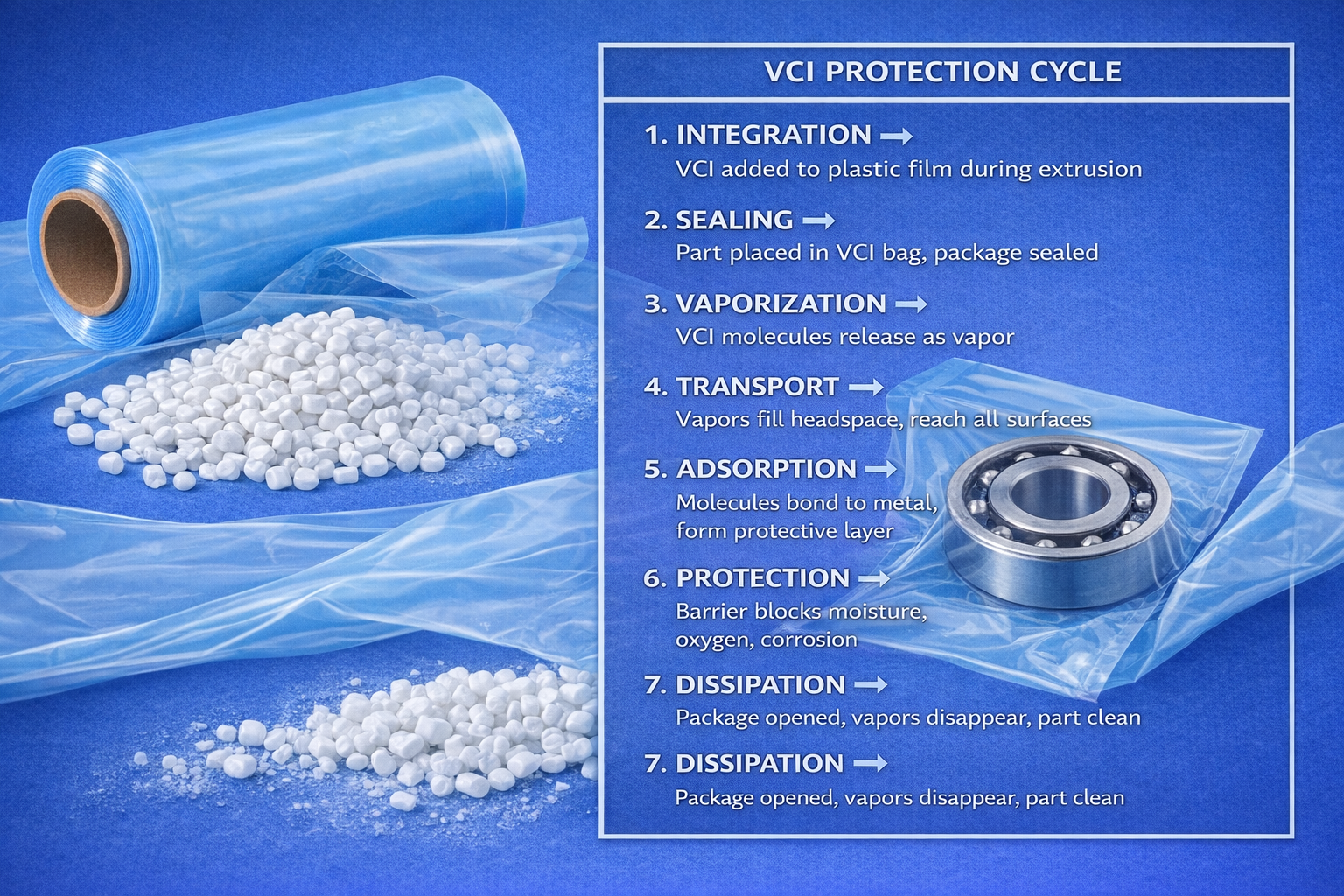
Step 1: Integration into Packaging Material
The VCI chemistry is compounded into the packaging material during manufacturing. For plastic films, this means adding a VCI masterbatch or powder during extrusion. The VCI molecules become evenly distributed throughout the polymer matrix.
Step 2: Volatilization Inside Sealed Packaging
Once the metal part is placed inside and the package is sealed, the VCI molecules begin to volatilize—they release from the packaging material as a vapor and fill the enclosed headspace. This happens naturally at ambient temperatures.
Step 3: Vapor Transport to Metal Surfaces
The VCI vapors travel throughout the sealed environment. Because they are airborne, they reach every exposed surface, including:
Complex geometries
Deep crevices and blind holes
Threaded areas
Interior cavities
Stacked or nested parts
This is a critical advantage over liquid coatings that cannot reach these hidden areas.
Step 4: Adsorption and Protective Layer Formation
When the VCI vapors contact a metal surface, they adsorb (bond) to it, forming a protective layer just one molecule thick. This invisible barrier:
| Function | How It Protects |
|---|---|
| Blocks Moisture | Prevents water molecules from reaching the metal surface |
| Displaces Oxygen | Creates a barrier that oxygen cannot penetrate |
| Interrupts Electrochemical Reaction | Stops the cathodic and anodic reactions that cause rust |
| Passivates the Surface | Makes the metal surface less reactive to corrosive elements |
Step 5: Continuous Replenishment
The VCI molecules are designed to provide long-lasting protection. If the protective layer is disturbed or dissipates, fresh VCI molecules from the packaging vaporize and re-adsorb onto the metal, self-replenishing the barrier.
Step 6: Clean Dissipation Upon Opening
When the package is opened, the VCI vapors simply dissipate into the surrounding air. The molecular layer on the metal detaches and evaporates, leaving the part:
✅ Completely clean
✅ Dry and residue-free
✅ Ready for immediate use, assembly, or finishing
No cleaning, degreasing, or solvent washing is required—saving significant labor and eliminating hazardous waste.
Q3: What Types of Metals Can VCI Plastic Packaging Protect?
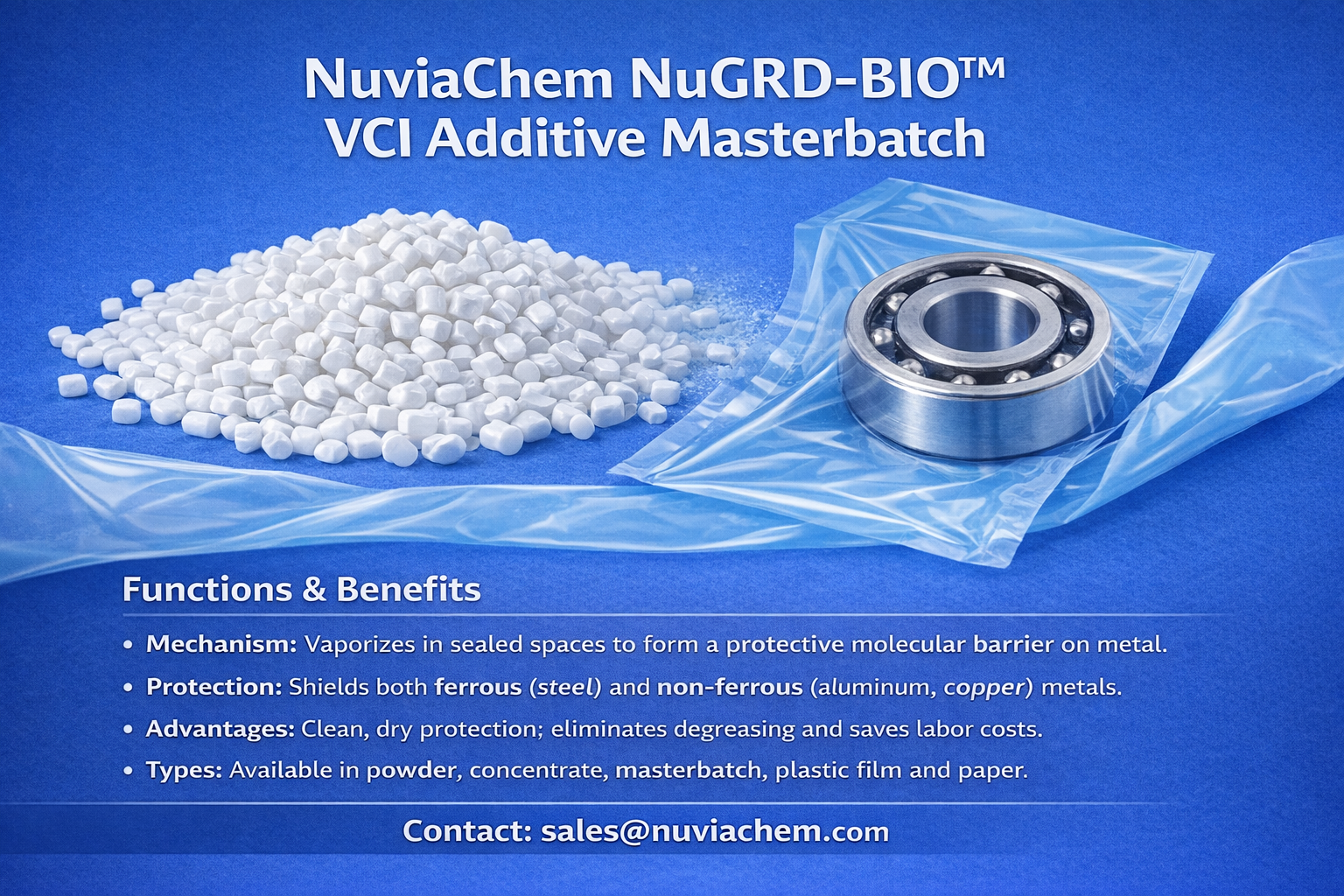
The best anti-corrosion additives for plastic packaging are formulated to be versatile. A high-quality solution like NuGRD-BIO™ VCI is designed for multi-metal protection, which is crucial if you package assemblies containing different metals.
You can expect protection for:
| Metal Type | Examples |
|---|---|
| Ferrous Metals | Steel, iron, cast iron, carbon steel, stainless steel |
| Non-Ferrous Metals | Aluminum, copper, brass, bronze, silver, zinc |
Always check the specific compatibility of the VCI chemistry with your exact metal mix, especially for sensitive applications involving exotic alloys or mixed-metal assemblies where galvanic corrosion is a concern.
Q4: What Are the Main Advantages of Using VCI Plastic Bags Over Traditional Rust Prevention Methods?
Protection Method Comparison
| Method | Pros & Cons |
|---|---|
| VCI Plastic (built-in inhibitor) | ✅ Clean, no labor, complex shapes, hidden areas, long-term ❌ Must seal properly |
| Oil/Grease (physical barrier) | ✅ Good short-term ❌ Messy, labor-heavy, needs cleaning, no hidden areas |
| Desiccants (absorb moisture) | ✅ Simple, low cost ❌ Only humidity control, saturates fast, no hidden areas |
| Vacuum Packaging (removes air) | ✅ Very effective for some ❌ High cost, shape limits, collapses, no chemical inhibition |
| Vapor Paper (similar to VCI) | ✅ Good protection ❌ Less durable, tears easily, paper only |
Bottom Line: VCI film is the only method combining clean, labor-free, and complete protection.
Q5: Can VCI Survive the High Heat of Plastic Film Extrusion?
Yes, but only if they are specifically engineered to do so. This is a critical technical point. The process of blowing or casting plastic film involves high temperatures:
| Plastic Type | Typical Processing Temperature |
|---|---|
| LDPE (Low-Density Polyethylene) | 160-220°C |
| LLDPE (Linear Low-Density) | 190-240°C |
| HDPE (High-Density Polyethylene) | 200-260°C |
| PP (Polypropylene) | 220-280°C |
If the VCI additive degrades in the extruder, it loses its effectiveness and can even cause defects in the film. Look for a high-temperature stable VCI specifically designed to withstand these conditions.
For instance, NuviaChem’s NuGRD-BIO™ VCI is explicitly engineered to survive polymer extrusion and film blowing processes without thermal degradation, ensuring the VCI chemistry remains fully active in the final film.
Q6: How Do I Choose the Right VCI for My Application?
Selecting the correct anti-corrosion additives for plastic film depends on several factors. Use this decision framework:
Step 1: Identify Your Metals
| If you protect… | Look for… |
|---|---|
| Steel only | Standard ferrous VCI formulation |
| Mixed metals (steel + copper + aluminum) | Multi-metal VCI formulation |
| Sensitive electronics | Low-outgassing, non-corrosive VCI |
Step 2: Determine Protection Duration
| Protection Needed | Loading Level Consideration |
|---|---|
| 30-90 days (transit) | Lower loading (1,500-3,000 ppm) |
| 6-12 months (storage) | Medium loading (3,000-6,000 ppm) |
| 2+ years (long-term) | Higher loading (6,000-10,000 ppm) |
Step 3: Assess Environmental Conditions
| Condition | Requirement |
|---|---|
| High humidity | Higher loading, good sealing |
| Salt air (marine transport) | Specialized marine-grade VCI |
| Temperature fluctuations | Stable VCI chemistry |
| Outdoor storage | UV-stable film + VCI |
Step 4: Consider Sustainability Goals
| Goal | Look For |
|---|---|
| Renewable content | Bio-based VCI |
| Worker safety | Nitrite-free, amine-free formulation |
| Global compliance | REACH, RoHS, EN71 Part 3 certified |
| Low environmental impact | Heavy-metal-free chemistry |
Step 5: Match Packaging Material
| Base Material | Compatible VCI Form |
|---|---|
| LDPE, LLDPE, HDPE | Masterbatch or powder |
| PP | High-temp stable formulation |
| Paper/Board | Liquid or powder treatment |
| Bioplastics (PLA, PBAT) | Compatible bio-based VCI |
NuviaChem’s NuGRD-BIO™ is compatible with polyolefins, PLA, and PBAT, with recommended loadings from 1,500 ppm to 10,000 ppm depending on these exact factors.
Q7: Is VCI Technology Safe and Environmentally Friendly?
Modern VCI technology has evolved significantly. While older formulations sometimes contained components like nitrites or amines, today’s advanced solutions focus on safety and sustainability.
What to Look for in a Responsible VCI Additive:
| Feature | Why It Matters |
|---|---|
| Bio-Based Content | Made from renewable sources, reduces carbon footprint |
| Nitrite-Free | Eliminates potential carcinogen concerns |
| Amine-Free | Reduces odor and skin sensitivity risks |
| Heavy-Metal-Free | Safe for disposal, meets strict regulations |
| Low Odor | Improves worker satisfaction, suitable for consumer goods |
| REACH Compliant | Meets stringent EU chemical regulations |
| RoHS Compliant | Safe for electronics and electrical equipment |
| EN71 Part 3 Compliant | Safe for toys and children’s products |
A clean, bio-based VCI like NuGRD-BIO™ not only protects your parts but also supports worker safety, corporate sustainability goals, and global market access.
Q8: What Industries Benefit Most from VCI Plastic Packaging?
The applications are vast, but some of the biggest adopters of VCI plastic bags and films include:
| Industry | Typical Applications |
|---|---|
| Automotive | Engines, transmissions, gears, bearings, brake components, stampings, fasteners |
| Aerospace & Defense | Turbine blades, landing gear components, avionics, tools, spare parts, munitions |
| Industrial Manufacturing | Hydraulic components, valves, pumps, machinery parts, tools, dies, molds |
| Electronics | Connectors, circuit boards, metal housings, enclosures, precision components |
| Oil & Gas | Pipeline fittings, valves, instrumentation, drilling equipment |
| Marine | Engine parts, hardware, fittings, tools exposed to salt environments |
| Export Packaging | Any metal goods shipped internationally via ocean freight |
| Military Storage | Long-term preservation of vehicles, weapons, spare parts |
Conclusion: Building Protection into Your Packaging
Switching to VCI plastic packaging is a strategic move from reactive problem-solving (dealing with rust after it happens) to proactive prevention. By integrating anti-corrosion additives for plastic packaging directly into your film or bags, you create a packaging system that actively works to preserve your product quality, reduce waste, and enhance customer satisfaction.
Key Takeaways:
✅ VCI technology uses vapor-phase action to protect metals without direct contact
✅ Protection reaches complex geometries and hidden areas that coatings cannot
✅ Parts emerge clean and ready to use—no cleaning or degreasing required
✅ Modern VCI additives are bio-based, safe, and environmentally responsible
✅ Choose your VCI based on metal type, duration, environment, and sustainability goals
- Learn more about Develop High-Performance Anti-Corrosion Packaging Films With Bio-Based VCI Technology
- Learn more about The Ultimate Q & A Guide to VCI Plastic for Metal Protection
- Learn more about How VCI Plastic Film Prevents Rust and Corrosion During Storage and Shipping.
- Learn more about How VCI Vapor Corrosion Inhibitor Film Protects Metal Components Without Oils or Grease.
- Learn more about VCI Paper vs. VCI Plastic Film: Which Corrosion Protection Solution Delivers the Best Value?
Ready to learn how NuviaChem’s NuGRD-BIO™ VCI can be tailored to your specific film, paper, or packaging application?
👉 Contact our technical team today to discuss your metal protection challenges. Tell us about your parts, packaging materials, and protection requirements—we’ll recommend the optimal VCI solution and provide samples for testing.
📌 Quick Reference: VCI Terminology
| Term | Meaning |
|---|---|
| VCI | Volatile Corrosion Inhibitor |
| Vapor Phase Inhibition | Protection via airborne molecules |
| Adsorption | Bonding of VCI molecules to metal surface |
| Monomeric Layer | Protective barrier one molecule thick |
| Ferrous Metals | Metals containing iron (steel, cast iron) |
| Non-Ferrous Metals | Metals without iron (aluminum, copper, brass) |
| Masterbatch | Concentrated additive for plastic processing |
| Loading Level | Concentration of VCI in packaging material (ppm) |

Protection Additive Solutions
⚙ VCI Anti-Corrosion
Advanced Vapor Corrosion Inhibitor (VCI) additive solutions engineered to protect metal components from rust, oxidation, and corrosion during storage and transportation.
🐭
Anti-Rodent & Pest Additives
Specialized anti rodent plastic additives designed to deter rodents and pests from damaging cables, pipes, and plastic infrastructure in critical installations.
🛡
Antimicrobial Additives
High-performance antimicrobial additives formulated to inhibit bacterial, mold, and fungal growth in plastics, textiles, and paper-based materials.