
2026 Guide to Antimicrobial Plastic Additives: Applications, Trends and Solutions
As we move through 2026, the demand for self-sanitizing materials has shifted from a niche advantage to a baseline expectation—a transformation accelerated dramatically by the COVID-19 pandemic. What began as an urgent response to a global health crisis has evolved into a permanent shift in consumer and industrial awareness. In the plastics industry, this means antimicrobial plastic additives are no longer just an upgrade or differentiator; they are becoming integral to product design across medical, consumer, and industrial sectors. Manufacturers and product developers now recognize that built-in antimicrobial protection is not merely a feature, but a fundamental expectation for products that prioritize safety, hygiene, and long-term value.
The challenge for manufacturers and product developers is not just finding an additive, but selecting the right advanced antimicrobial solution for polymers that offers proven efficacy, withstands manufacturing processes, and meets regulatory standards without compromising material integrity.
This guide explores the latest trends driving the market and introduces next-generation technologies designed to meet these complex demands.
The Evolution of Antimicrobial Technology in Plastic Materials
From Surface Treatments to Built-In Polymer Protection
Early antimicrobial approaches relied on surface coatings that could wear away through cleaning, handling, or environmental exposure. Today, the gold standard is built-in polymer protection, where the active agent becomes part of the material matrix itself. This ensures protection lasts the lifetime of the product, cannot be wiped off, and provides continuous antimicrobial activity.
The Shift Toward Hybrid Nanotechnologies
The most significant trend in 2026 is the move toward synergistic technologies. Single-mechanism additives can be effective, but they may have limitations in spectrum of activity or require specific conditions (like constant light) to work. The latest generation of multifunctional plastic antimicrobials combines different mechanisms to provide reliable protection in all conditions—dark or light, against bacteria or viruses, throughout the product’s entire lifecycle.
Introducing NuviaChem AntiMCBL Antimicrobial
Nano-Silver Based Antimicrobial Technology for Broad-Spectrum Efficacy
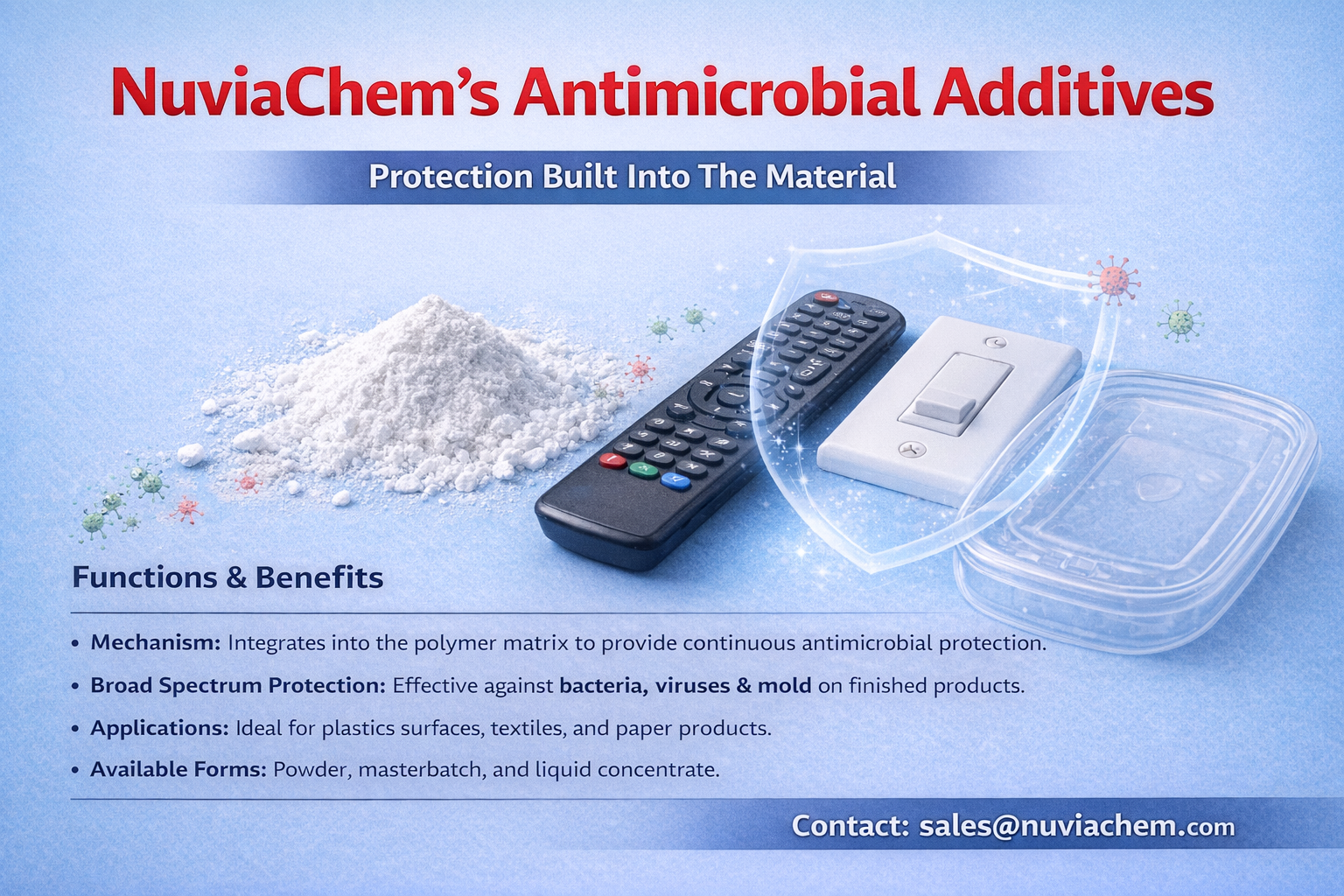
⚙️ Spotlight on Technology – The Dual-Action Advantage of AntiMCBL Antimicrobial Additive
One of the most advanced solutions available today is NuviaChem’s AntiMCBL Antimicrobial Additive, which exemplifies this new hybrid approach. Its technology is built on two complementary pillars that work together to deliver exceptional and continuous protection.
Nano-Silver Based Antimicrobial Technology for Broad-Spectrum Efficacy
Nano-silver particles are renowned for their broad-spectrum efficacy. With an exceptionally high surface area (10-11 m²/g), they maximize contact with microbes. The silver ions released disrupt cellular metabolism, inhibit essential enzymes, and block nutrient transport, effectively stopping bacteria and fungi from growing and multiplying. This mechanism is continuously active, working even in the dark and providing up to 99.9999% bacterial reduction.
Photocatalytic Titanium Dioxide for Antiviral and Self-Cleaning Action
Titanium dioxide (TiO₂) adds a powerful second layer of defense. When exposed to light, it acts as a photocatalyst, generating reactive oxygen species. These potent compounds aggressively decompose viruses, bacteria, and even odor-causing organic molecules, breaking them down into harmless by-products like carbon dioxide and water. This mechanism is particularly effective against viruses (achieving 99.99% viral reduction) and for keeping surfaces continuously clean and fresh.
By combining these two distinct technologies, AntiMCBL Antimicrobial Additive ensures robust protection across a wider range of pathogens and environmental conditions than any single-mechanism additive could achieve.
Thermally Stable Antimicrobial Polymer Additives
A primary concern for plastics processors is whether an additive can survive the production process. This is where thermally stable antimicrobial plastic additives are essential. Many engineering plastics—such as polycarbonate, PEEK, nylon, and PET—require processing temperatures well above 300°C.
An additive that degrades under heat loses its efficacy and can even cause discoloration, defects, or structural weaknesses in the final product. This is why thermal stability is a non-negotiable feature for many applications.
AntiMCBL Antimicrobial Additive is engineered with exceptional thermal resistance up to 600°C, providing complete peace of mind. Whether your process involves extrusion, injection molding, blow molding, or compression molding, the antimicrobial property remains fully intact and functional.
🏭 Key Applications for Antimicrobial Masterbatch in Plastics
The versatility of modern antimicrobial masterbatch for plastics allows it to enhance products across numerous markets. Here are the key application areas where it is making the biggest impact in 2026.
Medical & Healthcare Plastics
Infection control remains paramount. Antimicrobial additives are now standard in:
Medical devices: Catheters, tubing, surgical instruments, and device housings
Hospital furnishings: Bed rails, overbed tables, door handles, IV poles, and waiting area seating
Personal Protective Equipment (PPE): Components of masks, face shields, and eyewear
The ability to reduce Healthcare-Associated Infections (HAIs) by inhibiting pathogen growth on high-touch surfaces is a critical value driver in this sector.
High-Touch Consumer Goods
In homes, offices, and public spaces, frequently touched items benefit immensely from built-in protection.
Electronics: TV remotes, light switches, keyboard keys, mouse devices, and phone cases
Kitware: Mixing bowls, measuring cups, spatulas, and small appliance housings
Toys and childcare items: Providing an extra layer of safety for children
Sporting goods: Gym equipment, water bottles, and protective gear
Textiles & Non-Wovens
Beyond rigid plastics, this technology extends to fibers and fabrics.
Apparel: Sportswear, undergarments, socks, and workwear (for odor control)
Upholstery: Carpets, curtains, seating in public transport, healthcare, and hospitality
Filtration media: Air and water filters requiring prevention of biofilm growth
Coatings & Surface Protection
Antimicrobial additives for paints, varnishes, and industrial coatings create durable, hygienic surfaces. AntiMCBL Antimicrobial Additives have two grades: Grade S suits high-temp cure coatings and regulated medical/food applications. Grade C offers cost-effective protection for marine paints, industrial floors, and high-volume architectural coatings. Available in liquid dispersions for easy integration.
EPA-Compliant Antimicrobial Additives for US Market Access
In the US, antimicrobial additives are regulated by the Environmental Protection Agency under FIFRA. Using a non-compliant additive can result in costly product delays, market rejection by retailers, regulatory enforcement actions, and loss of customer trust.
AntiMCBL Antimicrobial Additive is available in EPA-compliant grades, providing you with:
A clear regulatory path to market
Complete documentation for your submissions
Confidence that your product meets US requirements
Competitive advantage over non-compliant alternatives
Manufactured Under Quality Standards
All AntiMCBL Antimicrobial Additives products are manufactured under ISO 9001:2015 systems and formulated with non-toxic, environmentally responsible components, supporting both regulatory confidence and sustainability goals.
📊 Antimicrobial Additives for Plastics – Product Comparison
To help you make the most informed decision, here is a side-by-side comparison of our two complementary antimicrobial solutions:
Antimicrobial Solutions: Grade S and Grade C Comparison
Grade S (Nano Silver + TiO₂)
Max Temp: 600°C (Great for engineering plastics like PC, PEEK, Nylon)
Compliance: EPA documented
Cost: Premium
Color: Minimal impact (ideal for clear/white)
Best for: Medical devices, high-heat applications, consumer goods
Grade C (Nano Copper)
Max Temp: 250°C (For commodity plastics like PE, PP, ABS)
Compliance: Consult for specifics
Cost: Cost-effective
Color: May impart slight color (best for pigmented systems)
Best for: Industrial products, automotive/marine, high-volume production
🏆 The NuviaChem Polymers Advantage
Unlike suppliers offering only one technology, we provide multiple solutions—and we support each with equal expertise.
When you choose nuviachem.com, you receive:
Unbiased technical guidance – We help you select the right product for your specific application, processing conditions, and budget
Best-in-class pricing on both Grade S and Grade C.
Regulatory documentation support for EPA-compliant applications
Sample quantities for testing under your actual processing conditions
Technical formulation assistance for optimal dispersion and performance
Multiple product forms to match your manufacturing process
📞 Conclusion and Next Steps
Incorporating an antimicrobial additive is a powerful way to add value, enhance safety, and meet the rising expectations of consumers and regulators—expectations that have been permanently shaped by the COVID-19 pandemic. By understanding the technology, the application trends, and the critical selection criteria, you can make an informed choice that benefits your product and your business.
Nuviachem’s AntiMCBL Antimicrobial additive represents the cutting edge of this technology, offering a dual-action, high-temperature stable, and regulatory-ready solution for plastics and beyond.
Looking for a More Cost-Effective Solution?
If your application:
Processes below 250°C (typical for PE, PP, PVC, PS, ABS)
Does not require EPA compliance
Needs excellent antifungal protection
Is driven by high-volume production budgets
Ask about our Grade C– Nano Copper Based Antimicrobial Additive. It delivers powerful antimicrobial efficacy at a significantly lower cost point, making it ideal for industrial applications, marine plastics, and value-conscious projects.
Our technical team can help you evaluate both options side-by-side.
👉 Contact us today to discuss your specific application, processing temperature, and budget. Tell us about your project, and we’ll recommend the right antimicrobial additive solution—and provide samples to prove it.

Related Protection Additive Solutions
⚙ VCI Anti-Corrosion
Advanced Vapor Corrosion Inhibitor (VCI) additive solutions engineered to protect metal components from rust, oxidation, and corrosion during storage and transportation.
🐭
Anti-Rodent & Pest Additives
Specialized anti rodent plastic additives designed to deter rodents and pests from damaging cables, pipes, and plastic infrastructure in critical installations.
🛡
Antimicrobial Additives
High-performance antimicrobial additives formulated to inhibit bacterial, mold, and fungal growth in plastics, textiles, and paper-based materials.